
News
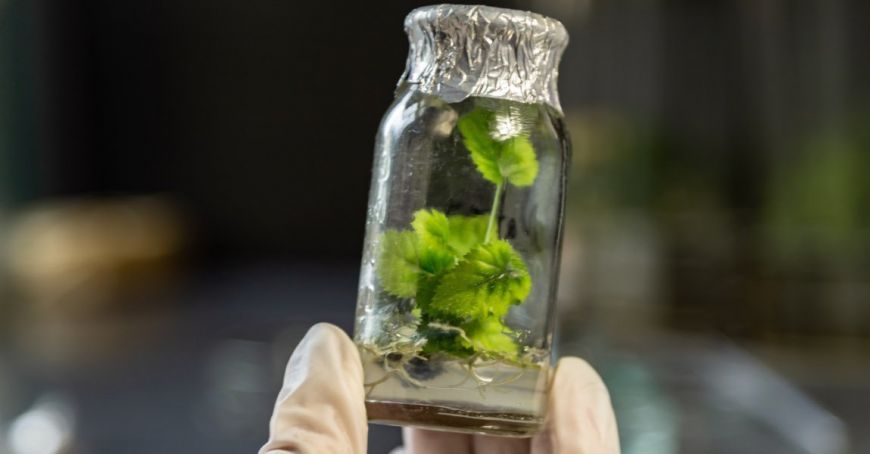
photo source: madein.md
Posted by: trm.md
News / Social
22 Feb. 2020 / 14:20
In vitro propagated plants at the Institute of Plant Genetics and Physiology
The "in vitro" procedure does not only apply to the conception of a child, but also to plants. Some 20,000 threads can be obtained from a single plant fragment. The operations are performed at the Institute of Genetics, Physiology and Plant Protection (IGFPP), transmits Moldova 1.
Laboratory researchers say that only from one plant fragment new ones can be created, which are becoming increasingly rare in the Republic of Moldova. To be multiplied, the samples are stored in glass containers with nutrients so the plant can grow.
"Vitro culture represents the growth of plants on artificial media in glass containers under aseptic conditions. Here is a vegetative multiplication of this plant. By the action of different physical or chemical factors we can induce the accumulation of secondary metabolites that are specific to the metabolites that accumulate in this plant,” mentioned Tatiana Călugărul-Spătaru, scientific researcher
In the laboratory, they reproduce the exotic plants that are on the verge of extinction.
"An exotic plant we can call it Minta Gatifosei, it is a medicinal plant from Morocco, it has a very limited cultivation area, up to 2,000 km, it is distinguished by the volatile oil that is extracted from it, it is very valuable and for this reason it is collected very intensely and is on the verge of extinction,” said Tatiana Călugărul-Spătaru.
Laboratory experts say they have been breeding plants in vitro since 1996.
"The laboratory has several research directions, one of the most important we consider, is the extraction from plants of biologically active substances and their use in agriculture and medicine, for which several expeditions were made in the Carpathians in Ukraine, Romania and Poland,” said Alexandru Dascaliuc, IGFPP director.
The growth of a plant in the tube takes 25 days. 12 species have already been multiplied under laboratory conditions.
Show Comments